Deep research on places: Reprompt vs GPT-5.5 with web search
We took 100 places straight from production traffic across Southeast Asia, Europe, and North America, ran them through Reprompt and GPT-5.5 with web search, and adjudicated every disagreement against primary sources.
Rob Balian
CTO @ Reprompt
Ask a frontier model with web search about a Starbucks in Seattle and it does fine. The interesting question is the other hundred million places — the barbershop in Lampung, the gîte in the Meuse, the motel mid-renovation in Virginia. That's where places data gets made or lost.
So we benchmarked it.
Reprompt does deep research on places: existence, closure, addresses, websites, hours, categories, chains — verified against primary sources, at API speed.
The benchmark
We sampled 100 places from real Reprompt production traffic over the last 30 days — not a hand-picked demo set: 34 from Southeast Asia (Indonesian and Malaysian long tail: shops, schools, food stalls, clinics), 33 from Europe and 33 from North America (heavily lodging and local services). Each place enters both systems with the same input: a name, an address, and coordinates.
- Reprompt — our production deep-research agent, out of the box.
gpt-5.5+ web search — one request to OpenAI's latest model with the web search tool, asking for the same attributes in the same schema.
We compared six attributes per place: open/closed status, opening hours, category, website, chain, and address. Where the systems disagreed head-to-head, independent judges adjudicated against primary sources — the business's own website and social profiles, not directories. We also audited the cases where only one system gave an answer.
Results
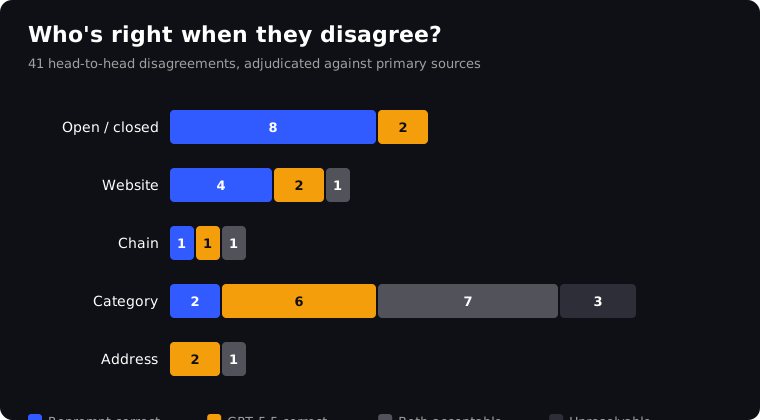
- On head-to-head disagreements, Reprompt wins 15 to 13 (10 "both acceptable", 3 unresolvable). Close overall — but not evenly distributed. On is this place open or permanently closed, Reprompt won 8 of 10 head-to-heads. On verified official websites, 4 of 6.
gpt-5.5punted on the hard places. It answered "Unsure" on open/closed for 27 of 100 places — almost all Southeast Asian long tail. Reprompt committed on all 100. Across all 25 adjudicable open/closed disputes and punts, Reprompt was right 80%.- A quarter of GPT-5.5's opening hours were wrong or invented. GPT returned hours for 20 places where Reprompt declined. Audited: only 7 of 20 traced to a primary source, and 5 of 20 were wrong or fabricated — one business got its neighbor's hours, one got a different barbershop's schedule, and vacation rentals were stamped "Open 24 hours".
- Reprompt produced a verified street-level address on 24 places where GPT-5.5 returned nothing. Address coverage is where deep research pays off most directly: no house number, no delivery.
- Where GPT-5.5 genuinely beat us: fine-grained categories (6–2 in its favor on the head-to-heads our judges could resolve) and chain recall — it correctly identified 7 real chain affiliations Reprompt missed, including a rebranded hotel and a franchised motorcycle workshop. We're shipping fixes for both.
Every head-to-head disagreement, adjudicated against primary sources.
"Unsure" is not a safe answer
The single biggest behavioral difference: when the evidence gets thin, gpt-5.5 shrugs.
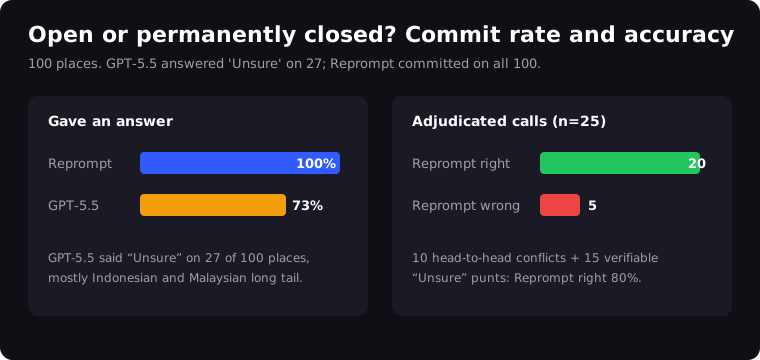
GPT-5.5 answered "Unsure" on 27 of 100 places. Reprompt committed on all 100 — and was right on 20 of the 25 calls our judges could verify.
For a maps or delivery platform, "Unsure" is a non-answer that someone still has to resolve. Reprompt's agent commits — including to the genuinely hard verdict "this business has no internet presence at this address," which our judges confirmed in 7 of 8 verifiable cases. The agent visits the sources, searches in the local language, and makes the call.
It also catches things a single web search structurally can't:
- KG Motel (Lexington, VA): GPT-5.5 said open and cited a website that's now a dead 404 with a broken TLS certificate. Reprompt said closed — the motel's actual site announces a Fall 2026 relaunch mid-renovation.
- Sonesta Select Houston IAH: GPT-5.5 resolved it to Hyatt Place at a different street. The property left Hyatt; Sonesta operates at that exact address today. Reprompt got the brand, website, and address right.
- Two "open" hotels that don't exist yet: GPT-5.5 reported Home2 Suites Logan and Canopy Deer Valley as open with 24/7 hours. Neither has opened — one breaks ground for a September 2026 opening.
The hours trap
Reprompt's deep research mode has a hard rule: opening hours ship only when they trace to the business's own website or official social profile. Directory sites — which republish each other for years after a business changes or closes — are never a valid final source. On this long-tail-heavy sample, that meant Reprompt shipped zero unverified hour-sets while gpt-5.5 shipped 20, sourced from the Restaurant Gurus and Menustics of the world.
Coverage win for GPT? We audited all 20:
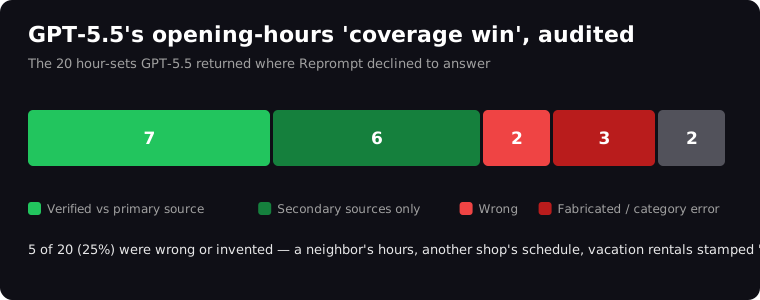
Only 7 of 20 verified against a primary source. 5 of 20 — 25% — were wrong or invented.
A confidently wrong "open until 10pm" sends a courier to a dark storefront. We'd rather return null and tell you why. (And where official sources do publish hours, our pipeline now extracts them deterministically from the visited page — that work shipped this week.)
Experiment setup
100 places sampled from the most recent 30 days of Reprompt production traffic (34 SEA / 33 EU / 33 NA), deduplicated, internal test traffic excluded. Both systems got identical inputs: name, full address, lat/lng — nothing else.
The GPT-5.5 harness is deliberately simple and fair: one request, web search enabled, a clean JSON schema matching our output, "only report what you can verify, use null otherwise." Median runtime: 49s for GPT-5.5, 65s for Reprompt.
Comparison was structural first (normalized addresses, chain sub-brands, cross-taxonomy category synonyms adjudicated by an LLM), so formatting differences never count as disagreements. The 41 substantive conflicts, the 27 "Unsure" punts, GPT's 20 hour-sets, and its 13 exclusive chain claims were then adjudicated by independent research agents with live web access, each verdict backed by a cited source.
Caveats
- The eval set comes from our own production traffic, which skews toward the long tail where deep research matters most. On head-of-distribution places (major chains, landmarks), the gap would narrow.
- A more elaborate multi-step agent built on GPT-5.5 would do better than one prompt — but then you're building, evaluating, and maintaining what we built.
- Agreement between two systems doesn't prove correctness; we only adjudicated disagreements and single-sided answers. And our judges, like all judges, can be wrong — every verdict in the dataset carries its evidence URL.
- GPT-5.5 earned its wins fairly: it's genuinely strong at fine-grained categorization and chain detection, and it's honest enough to say "Unsure". The difference is that "Unsure" is the beginning of our job, not the end of it.
What's next
We're extending the benchmark to Gemini and Claude with the same protocol, and publishing the eval set.
If you manage places data and want to see what deep research returns on your hardest records, get in touch — we'll run your sample for free.
Ready to get started?
Try Reprompt today and transform your location data.